
 Tiếng Việt


In modern all-ceramic restorations, IPS e.max is considered one of the most reliable materials thanks to its natural esthetics, high strength, and versatile handling across many clinical indications. However, although both belong to the e.max system, IPS e.max CAD and IPS e.max Press each carry distinct advantages. After many years of working with both, we have developed a clear decision-making protocol: always choose based on the balance between workflow efficiency and the specific clinical demands of each case.
When do I prioritize IPS e.max CAD? – Fast, workflow-optimized, highly efficient
The most outstanding advantage of IPS e.max CAD is its workflow efficiency. As a CAD/CAM block material, it allows seamless fabrication from design to finishing without waxing, investing, or pressing required in the e.max Press workflow.
Why IPS e.max CAD is often our first choice:
▪ Faster and cleaner workflow
No spruing, no investing, no casting cylinders — saving significant production time.
Just one design, one milling process, and the restoration can be completed within the same day.
▪ Can be adjusted intraorally in the “blue stage”
A major benefit we truly value. In its pre-crystallized (blue) stage, the material is firm enough for try-in but still soft enough for easy adjustments, reducing the risk of chipping during manipulation.
This is especially useful for cases requiring precise occlusal or contact adjustments.
▪ High consistency and easier quality control
Thanks to CAD/CAM, restorations have excellent repeatability — ideal for labs with high case volume or those prioritizing efficiency.
Therefore, for most routine cases — veneers, inlays/onlays, single crowns, implant restorations designed digitally — IPS e.max CAD remains the most efficient option: fast, accurate, time-saving, and still highly esthetic.

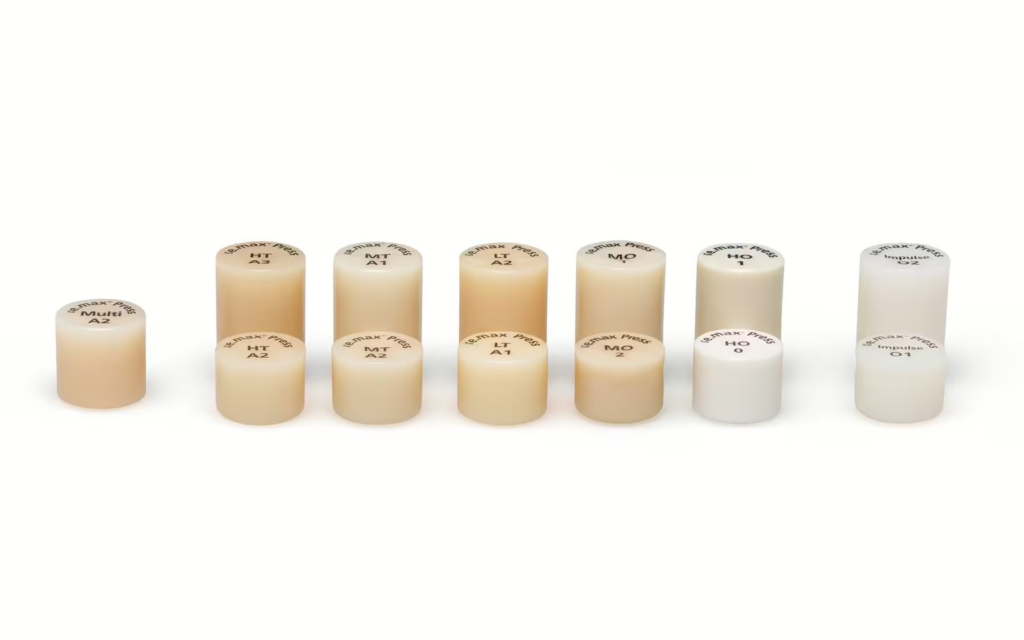
When is IPS e.max Press the optimal choice? – When finesse or technical flexibility is required
While e.max CAD is powerful, there are situations where we intentionally switch to e.max Press because of its unique strengths. IPS e.max Press is ideal when:
▪ Handling milling-challenging designs
Some restorations — such as tight interproximal areas, thin incisal edges, or fine anatomical details — may exceed milling limitations.
Pressing allows more refined morphology because it is based on wax patterns or digital wax-ups, not tool diameter.
▪ Special shades or increased brightness
A major advantage of e.max Press is the wide variety of ingots, especially those with higher brightness or opacity.
For cases requiring masking of dark stump shades or enhanced brightness, specific ingots offer results that CAD blocks may not always match.
▪ High-end esthetics with full customization
Anterior restorations demanding subtle translucency, incisal halo effects, and smooth shade transitions often look best when pressed and layered.
For patients with high esthetic expectations, e.max Press gives more room for customization — truly a “tailor-made” restoration rather than a “standard design.”
▪ Multi-unit restorations
For small bridges or multiple adjacent crowns, the pressed structure often provides stronger frameworks and excellent marginal precision — key for long-term stability.

Smart combination – Optimize each case instead of relying on a single solution
One thing we’ve learned through years of working with the e.max system:
No single material is perfect for every case.
e.max CAD offers workflow superiority.
e.max Press provides esthetic finesse and ingot versatility.
Using both strategically always yields the best outcomes.
Some strategies we apply:
- Use CAD for most single-unit restorations to maximize speed and blue-stage adjustability.
- Use Press for high-esthetic anterior cases or situations with milling limitations.
- Combine both in specific cases: for example, posterior veneers via CAD + anterior veneers via Press to achieve both efficiency and ultimate natural esthetics.
Conclusion
Both IPS e.max CAD and IPS e.max Press are exceptional materials — the question isn’t which is “better,” but which is right for the case.
- When speed, efficiency, and workflow flexibility are essential → Choose CAD.
- When brightness, esthetic finesse, and artistic customization matter → Choose Press.
By combining both intelligently, we can deliver restorations that are strong, beautiful, natural, and perfectly tailored to each patient.