
 Tiếng Việt


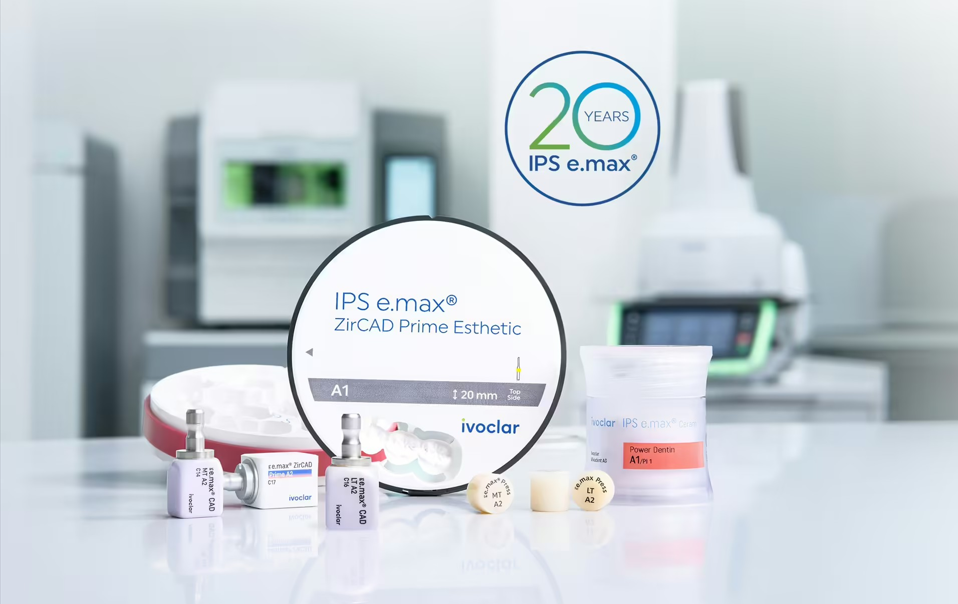
In the world of modern restorative dentistry—where esthetics, strength, precision, and workflow efficiency must go hand in hand—very few materials have been able to maintain their position as a true “benchmark” for more than a decade. IPS e.max is one of those rare exceptions.
More than just a material line, IPS e.max has become a shared language among dentists and dental technicians worldwide when it comes to high-end all-ceramic restorations. Behind this success lies a long-standing story of material science innovation, a clear development philosophy, and decades of accumulated clinical and laboratory experience.
Ivoclar’s Vision: Innovation Must Go Hand in Hand with Efficiency and Reliability
At Ivoclar, innovation has never meant simply “creating something new.” The company’s guiding philosophy has always been clear:
Every new generation of materials must be easier to use, more efficient, more reliable, and more esthetic than its predecessor.
IPS e.max is the clearest embodiment of this philosophy.
From its very beginning, IPS e.max was not just another ceramic material added to the market. It was conceived as a comprehensive material ecosystem for all-ceramic restorations, covering veneers, inlays/onlays, single crowns, short-span bridges, and more—while offering flexible application through both press technology and CAD/CAM workflows.

A Benchmark in Modern All-Ceramic Dentistry
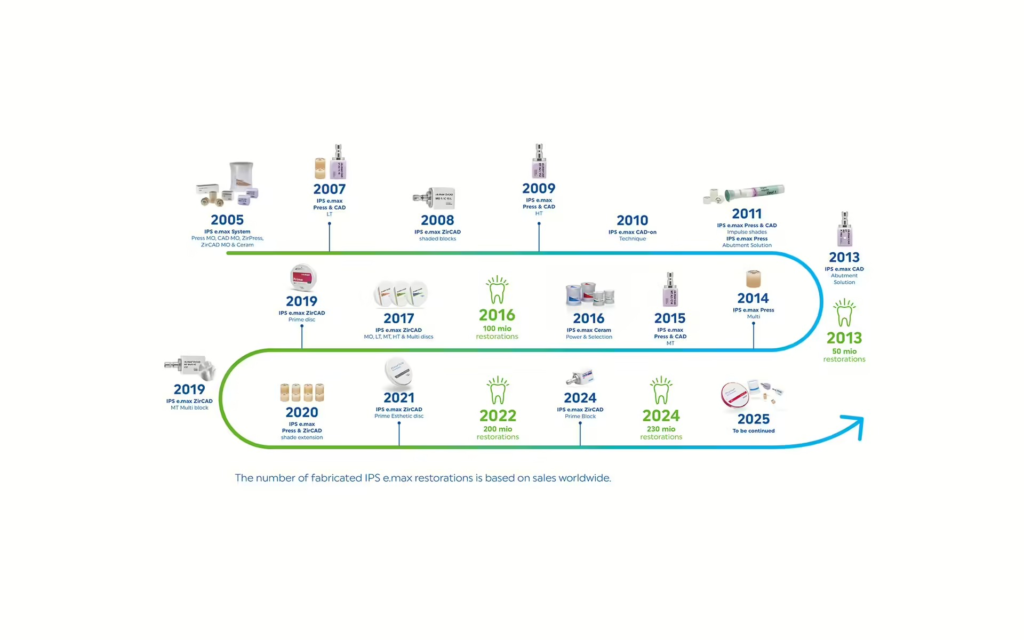
More than 20 years ago, Ivoclar made a strategic decision that would redefine all-ceramic dentistry: focusing on lithium disilicate glass-ceramics. This was a true turning point.
Lithium disilicate offers precisely the properties modern dentistry demands:
- High strength compared with conventional glass-ceramics
- Outstanding esthetics: translucency, depth, and excellent enamel-like appearance
- Long-term stability in the oral environment
- Excellent bonding capability, making it ideal for adhesive restorations
Building on this foundation, Ivoclar’s R&D team developed IPS e.max into a true all-ceramic standard—where the material is not only “beautiful,” but also stable, predictable, and consistent in both clinical and laboratory practice.
Today, IPS e.max is one of the most widely used glass-ceramic systems worldwide, trusted in millions of restorations every year.
Superior Quality Rooted in Advanced Manufacturing Processes
One of the core factors behind the success of IPS e.max is its integrated glass-ceramic manufacturing process, which is strictly controlled from start to finish.
Advanced Glass-Ceramic Technology
IPS e.max lithium disilicate materials are produced through several carefully coordinated stages:
- Glass melting
- Controlled cooling
- Crystal nucleation
- Crystal growth
This process creates a homogeneous lithium disilicate crystal structure, allowing the material to achieve an optimal balance between mechanical strength and optical esthetics.
Homogeneous, Flawless Color
Homogeneous, Flawless Color
To achieve precise coloration, Ivoclar uses multivalent ions dissolved directly within the glass phase. As a result:
- Color is uniformly distributed throughout the entire material
- Color streaks, spots, and shade inconsistencies are eliminated
- High consistency is ensured across different production batches
Throughout manufacturing, all parameters are continuously monitored and optimized, ensuring that every IPS e.max block delivered to the laboratory meets the highest standards of quality and consistency.
IPS e.max CAD – Optimized for Digital Workflows
Partially Crystallized CAD Blocks – A Key Advantage
A defining feature of IPS e.max CAD is its partially crystallized state at delivery. In this condition, the material exists in a blue crystalline intermediate phase, commonly known as the blue state.
The advantages of this state include:
- Easier milling with reduced tool wear
- Excellent edge stability, minimizing chipping
- Sufficient strength for highly precise machining
Structurally, this phase contains lithium metasilicate crystals, which allow the material to be both easy to mill and dimensionally accurate.
Post-Milling Crystallization – Where Esthetics Come to Life
After milling, the restoration is placed in a ceramic furnace for crystallization. During this step:
- The material reaches its maximum mechanical strength
- Final shade and translucency are fully developed
- The lithium disilicate crystal structure is completed
This process enables technicians to actively control esthetics, combining staining, glazing, or layering depending on the specific clinical requirements.